SOURCES · AUTHORS · LICENSES
Credits
Meet the people and sources behind Solar Time's science, imagery, textures, music, and artwork.
Created by
Life User designed and maintains the application, interface, camera system, rendering, interactions, explanatory writing, and the original visual presentation.
Scientific purpose
Solar Time is an educational and ambient visualization. It is not a precision ephemeris, navigation system, or mission-planning tool.
Astronomy and orbital references
Planetary positions are based on approximate and long-term orbital models published by NASA/JPL. Reference states are checked offline against JPL Horizons. The Moon, Europa, Triton, Pluto, eclipses, and alignment views use dedicated project models. The released application does not contact JPL Horizons while it runs.
- NASA/JPL approximate positions of the planets provides the orbital elements and correction terms used to calculate planet positions across Solar Time's supported dates.
- NASA/JPL Horizons supplies reference vectors used by the offline validation suite to check selected dates. Solar Time does not query Horizons while visitors use the site.
- NASA/NSSDCA planetary fact sheets provide physical reference values such as body dimensions, gravity, temperature, and rotation data shown in the information cards.
- Astronomy Engine by Don Cross provides precision routines for the Moon and Europa positions and for solar-eclipse searches. It is redistributed under the MIT License.
Planet imagery and textures
Triton map: NASA/JPL-Caltech/Lunar & Planetary Institute, Voyager 2 (PIA18668). The displayed map is an OpenAI ImageGen artistic reconstruction using this reference, with unobserved northern terrain completed and grid lines removed; the added terrain is not observational data. Triton uses the JPL NEP097 mean orbital elements, including its retrograde orbit and nodal precession, rather than a full numerical ephemeris.
Earth imagery includes NASA Earth Observatory Blue Marble and Black Marble references. Venus uses NASA Magellan radar imagery for its surface. Several planet and Moon maps are derived from the Solar System Scope texture collection by INOVE under the Creative Commons Attribution 4.0 license. Each map is prepared into multiple levels of detail for the Solar Time renderer.
- NASA Earth Observatory · Blue Marble Next Generation is prepared as the daylight surface of Earth. It is a global composite rather than a live satellite image.
- NASA Earth Observatory · Earth at Night provides the 2016 Black Marble source used for lights on Earth's night side. It is an annual composite, not live electrical activity.
- Natural Earth · Admin 0 Countries supplies the public-domain boundary vectors used for country hover outlines. Solar Time keeps only supported regions and simplifies them for lightweight display.
- NASA/JPL-Caltech · Venus Magellan radar mosaic forms the cloud-free Venus surface used by the visualization. It is radar-derived simulated colour, not a visible-light photograph.
- Solar System Scope / INOVE texture collection supplies licensed maps for Mercury, Venus's atmosphere, the Moon, Mars, Jupiter, Saturn, Neptune, and Saturn's rings.
- Creative Commons Attribution 4.0 International is the license governing the Solar System Scope maps. Solar Time retains the required attribution and source links on this page.
Named stars and constellations
The fixed constellation layer uses selected J2000 star positions from the HYG Database by David Nash / Astronexus, alongside the existing SIMBAD positions for the Big Dipper and Polaris. The reduced HYG table retains positions, magnitudes and spectral classes and adds illustrative colours. This derived table remains available under Creative Commons Attribution-ShareAlike 4.0.
The connecting-line topology is adapted from the Stellarium Western sky culture under Creative Commons Attribution-ShareAlike. Solar Time derives its own reveal order and rendering. These guides are recognisable Western patterns, not official constellation boundaries. Named-star directions are fixed; their display depth, size and twinkle are adjusted for readability. The surrounding decorative stars are generated independently.
Original and AI-assisted artwork
The space background, procedural stars, dust, haze, fallback materials, corona, rings, and supporting effects are project-authored unless another source is identified. Sun, Pluto, Uranus, and Europa maps are artistic spherical reconstructions created for Solar Time with OpenAI ImageGen from named NASA or USGS references. Flight particles and ring-tour debris are also original generated assets made for this project. These images are illustrative and are not measured all-sky maps or photographs.
Music and alarm audio
- BACKGROUND MUSIC SUNO AI - Lyrikey. Original ambient tracks accompany the solar-system view and travel sequences.
- Deep Space Journey - Maryan Dembitskyi. This artist-provided track joins the background music rotation.
- Soft Morning - Maryan Dembitskyi. Provided through Pixabay for free use, this track plays as the default alarm.
Solar surface and effects
Solar Time adapts the exterior rays and arches from Realistic Sun by Tibi. The surface and soft glow are Solar Time shaders; the adapted effects share its renderer and use adjusted colours and motion.
Original source download · Author’s usage permission. The bundled Three.js renderer is distributed under the MIT License and attribution notice.
Rebuilding the Sun
From a single texture to a flowing surface with rising arches of light.
The rays and arches in Tibi's Realistic Sun were an important starting point for this upgrade. We combined those publicly shared effects with Solar Time's surface and soft glow, adapting their colours and behaviour to our camera system through repeated visual experiments.
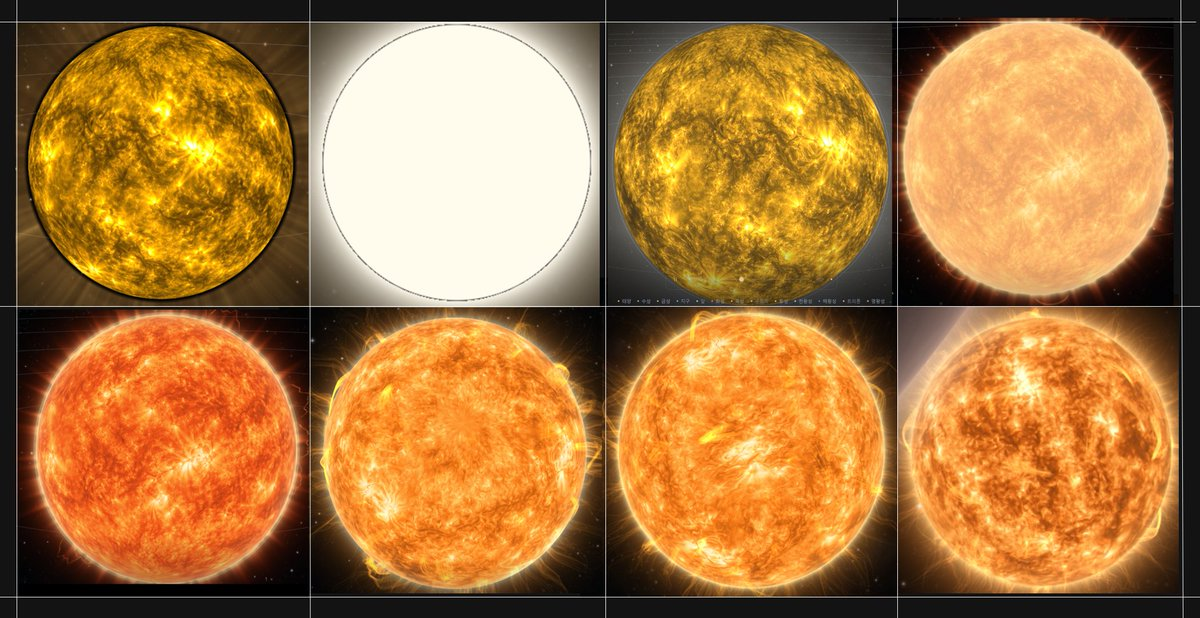
- Starting with the original Sun. A yellow surface texture and radial shine could not provide the look we wanted for both sunrise during travel and close views of the surface.
- Balancing light and detail. We tested a bright white disc, broader glow, and different texture blends. Comparing washed-out surfaces and visible borders helped us refine brightness and the transition from surface to glow.
- Bringing the surface to life. We adjusted texture flow and the balance of bright and dark regions, while reducing repeated patterns at the poles and bands around the edge.
- Integrating rays and arches. We adapted Tibi's exterior effects to Solar Time's surface and soft glow, reworking their colours, motion, and occlusion rather than importing the entire original implementation.
- Refining the result during travel. We repeatedly compared the overview, close views, and sunrise from Mars, tuning yellow, orange, and red tones alongside surface contrast and the spread of light.
- Reducing rendering work. We removed the original cubemap, shared the existing renderer, and adjusted ray counts for a small Sun and how effects are prepared. Performance still varies with screen size and hardware.
The surface and soft glow were implemented for Solar Time; the exterior rays and arches were adapted from Tibi's publicly shared work. The result is an artistic visualization, not observational footage or a physical simulation.
Sources: Realistic Sun demo · Original source · Author's usage permission · Attribution and licenses
Source preparation and limitations
Large maps are resized into several levels of detail so distant bodies can load a smaller texture before a close view uses higher resolution. This processing preserves the source artwork but does not create new measured surface detail.
Earth's cloud and night-light layers are fixed composites rather than live weather or electrical activity. Saturn's ring map is converted into a radial colour-and-transparency profile, while procedural materials may appear temporarily during loading or in compatibility mode.
Planet sizes, orbit spacing, texture colours, unobserved terrain, event presentation, and travel effects may be adjusted for legibility. Alignment dates generated by Solar Time are model results and are not named official astronomical events.
Corrections and licensing
If an attribution needs correction, or if you have a question about a source or license, contact Lyrikey@Naver.com. Source records are updated when assets or scientific references change.